

USPTO to Clarify Patent Eligibility for AI-Related Inventions
The United States Patent and Trademark Office (USPTO) is changing how examiners review software inventions, especially those involving artificial intelligence (AI). Updates to the Manual of Patent Examining Procedure (MPEP) aim to bring clarity to the review framework after years of inconsistent outcomes among examiners and in appeal decisions, and could make more AI-related inventions eligible for patent protection.
How Examiners Evaluate Patent Applications
A basic requirement of patentability is that a claimed invention relate to patent-eligible subject matter under 35 U.S.C. § 101. In 2014, the United States Supreme Court in Alice Corp. Pty. v. CLS Bank Int’l set out a framework for examiners and courts to determine whether a claimed invention satisfies the statute. The framework is shown in the flowcharts below:
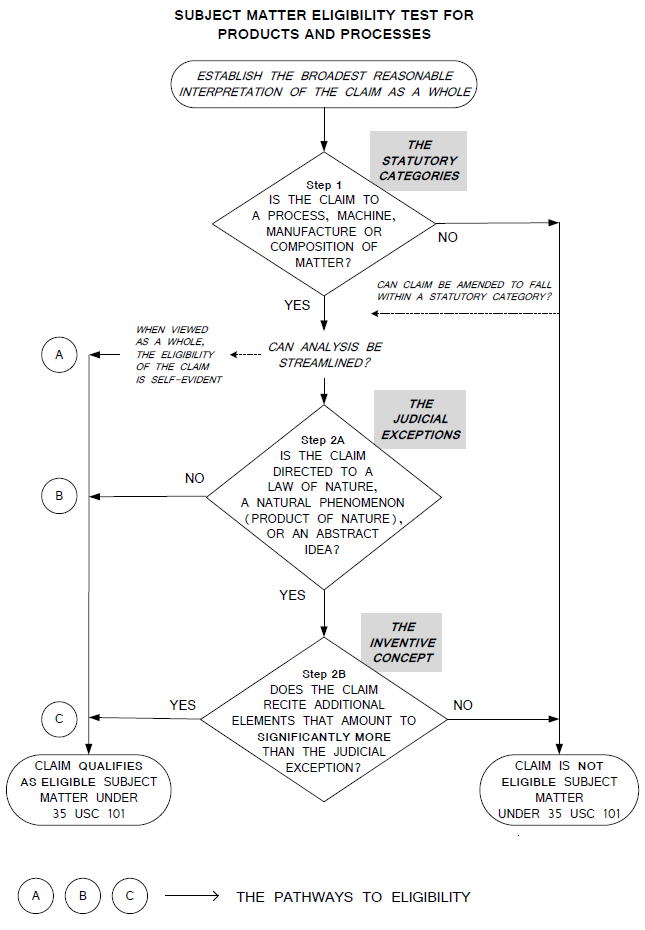
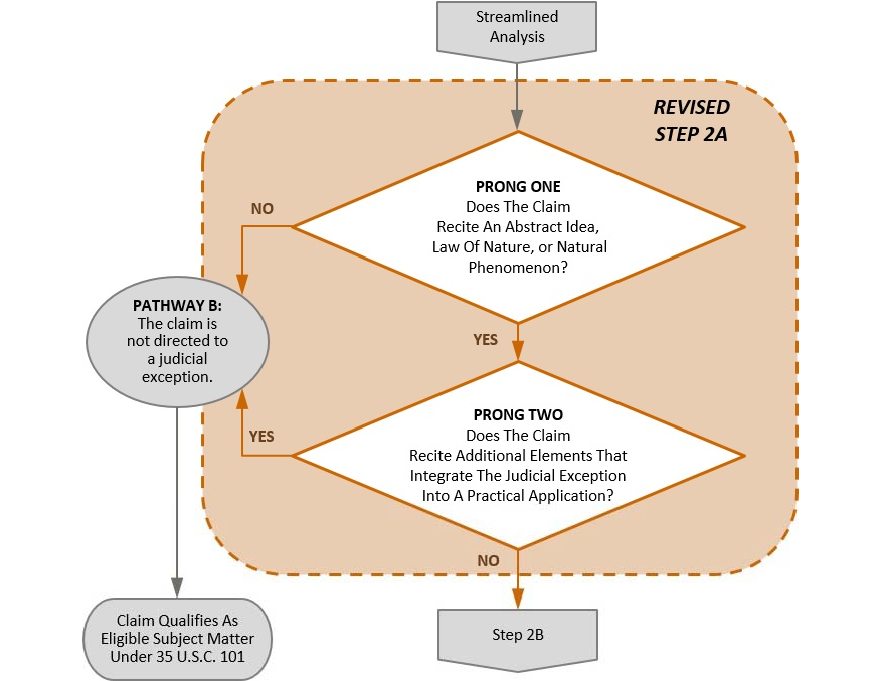
As the flowcharts show, the first question is whether the claimed subject matter falls within one of the four categories of patent-eligible subject matter: a process, machine, manufacture, or composition of matter. If not, the claim fails and is rejected under § 101. If so, the analysis proceeds to step two of the Alice framework, which is divided into steps 2A and 2B.
Step 2A is often the most difficult part of the analysis. It asks whether the claim is “directed to” a law of nature, a natural phenomenon, or an abstract idea (each a “judicial exception”). Step 2A itself has two prongs, and a claim can satisfy § 101 in either of two ways. Under prong one, the claim is eligible if it is not directed to a judicial exception. Under prong two (i.e., step 2B), even if the claim is directed to a judicial exception, it may still be eligible if it recites additional elements that integrate the exception into a practical application — i.e., elements that “amount to significantly more” than the judicial exception itself. If the claim satisfies prong two (i.e., step 2B), it passes step 2 overall and is patent eligible subject matter under § 101.
Although the Supreme Court’s decision in Alice clarified eligibility in some contexts, it did not define “abstract idea,” leaving examiners and lower courts to make that determination on a case-by-case basis. As a result, claims to software-related inventions have faced heightened scrutiny over whether they are directed to an “abstract idea” and then, whether they recite “significantly more” than the abstract idea. Many software claims recite logic carried out by a processor executing machine-readable object code — often involving ways to organize, transform, or present data, or algorithms that process inputs to produce outputs. For § 101 purposes, the drafting challenge is to describe a concrete technical improvement and its real-world application that adds “significantly more” than the abstract idea.
The USPTO’s Policy Shift in the Wake of the AI Wave
Since generative AI gained mainstream adoption in 2022, engineers and developers have introduced new approaches across computing and software. As AI-driven innovation accelerated, inventors increasingly turned to patent filings to protect AI-centric inventions. This led to an influx of software applications at the USPTO, which ushered in an increase in denials and subsequent appeals. Recent decisions by the Appeals Review Panel (ARP) of the Patent Trial and Appeal Board (PTAB), however, reflect a shift in how the USPTO is treating software-related claims. The USPTO is now reinforcing that shift through proposed MPEP updates and an accompanying memorandum.
In Ex Parte Desjardins, the PTAB issued a § 101 rejection of an application claiming a method of training an AI/machine-learning model. The method allowed the model to learn new tasks while protecting knowledge from prior tasks, addressing the common problem of “catastrophic forgetting.” Applying Alice’s step 2A, the PTAB found that the claims were directed to an abstract idea (failing prong one) and did not recite “significantly more” additional elements integrating that idea into a practical application (failing prong two).
The ARP disagreed as to prong two, concluding that the claims did integrate the alleged abstract idea into a practical application by including “significantly more.” In support, the ARP cited Enfish, LLC v. Microsoft Corp., in which the U.S. Court of Appeals for the Federal Circuit recognized that many advances in software and computing consist of improvements defined by logical structures and processes rather than physical features. The Federal Circuit asserted that because software can make non-abstract improvements to computer functionality, eligibility may turn on whether claims are directed to an improvement in computer functionality or another technology or technical field, rather than to an abstract idea.
Following the ARP’s decision in Ex Parte Desjardins, the USPTO issued an advance notice of change to the MPEP on December 5, 2025. The proposed updates incorporate Ex Parte Desjardins as guidance for examiners and courts applying Alice step 2A to software-related claims. The USPTO emphasized that the updates are not intended to create new practices or procedures, but rather to align the MPEP with existing guidance.
Since the advance notice, the PTAB has applied this Desjardins-aligned approach by reversing an examiner’s § 101 rejection of claims directed to an AI-based business method. In Ex Parte Carmody, the claims were directed to “AI based orchestration of marketing, sales, and customer lifecycle strategies to help companies grow their businesses and customer relationships.” The PTAB agreed with the examiner that the claims failed step 2A prong one because they recited an abstract idea — particularly a method of organizing human activity and a mental process. But the claims satisfied step 2 prong two (i.e., step 2B) because they recited a method of training an AI model to improve overall performance. Although the claims did not specify how the improvement benefited the overall system, the PTAB concluded that the specification’s description of the method’s advantages was sufficient to integrate the abstract idea into a practical application, allowing the application to pass step 2B and, ultimately, § 101. Ex Parte Carmody thus provides additional evidence of the PTO’s evolving approach to software inventions, including those incorporating AI.
Guidance for a Would-Be AI Software Patent Applicant
As the PTO signals a more applicant-friendly approach to software and AI-centric applications, applicants may face fewer eligibility headwinds. When preparing an application or working with patent counsel, inventors should focus on articulating — clearly and concretely — what is new in the software and how it improves computer functionality or another technical field.
It can be tempting to emphasize conceptual features or high-level benefits. But for § 101 purposes, applicants are often best served by pointing to specific technical details mapped to specific limitations in the claims, and explaining how those details integrate any alleged abstract idea into a practical application.
While this may already seem like an obvious approach, the USPTO’s proposed MPEP updates reinforce that focus and make it a fundamental aspect in establishing patent eligibility. The MPEP is to be revised in “due course” to implement the changes highlighted in this article.
Contact Jack LeDoux, Drew Patty or any member of the Phelps intellectual property or artificial intelligence teams with questions.